
Have you ever encountered terms like ‘bloom’ or ‘gelatine mass’ in a recipe and felt a little lost? Perhaps you’ve tried using gelatine, only for your dessert not to set quite right?
Worry no more! In this comprehensive guide, I’ll demystify everything you need to know about gelatine. We’ll cover how to use it correctly, understand different strengths and forms, and even adapt recipes based on what you have available. Get ready to achieve perfectly set, beautifully textured results every time!
What is Gelatine?
Gelatine is a translucent, colourless, and flavourless food ingredient derived from collagen, primarily sourced from animal by-products. It functions as a gelling agent, imparting a characteristic jelly-like texture to food products. When dissolved in hot liquid and subsequently cooled, it undergoes a transformation to form a stable gel, making it an indispensable component in a wide array of desserts such as jellies, mousses, and certain custards, as well as various savoury applications.
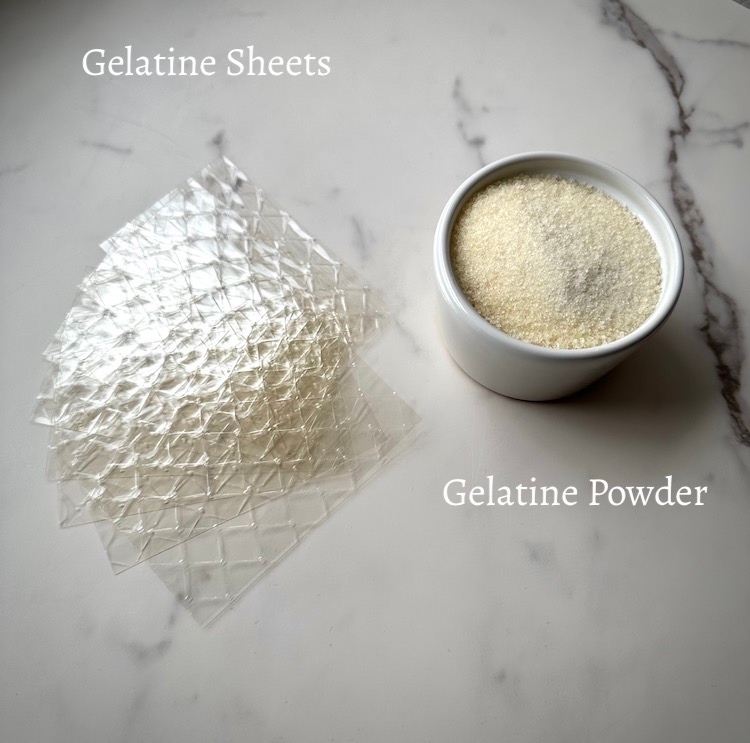
Gelatine is commonly available in two forms: sheet (or leaf) and powder. Sheet gelatine is typically derived from bovine (cow) or porcine (pork) sources, while powdered gelatine can be produced from bovine, porcine, fish, and occasionally chicken (though less common).
While both forms achieve the same gelling effect, their handling methods differ significantly, which we will explore in detail shortly.
What is bloom?
When a recipe specifies a ‘bloom’ value (e.g., 10g gelatine sheet (200 Bloom)), it refers to the strength of the gelatine. Gelatine’s gelling power varies based on its source and production, and these strengths are categorised by bloom values or grades.
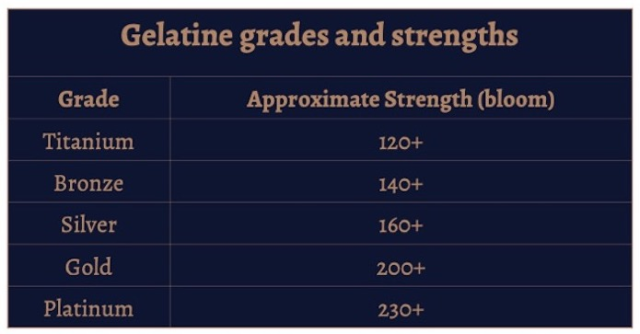
Knowing the bloom value or grade is crucial for a recipe’s success. If a recipe calls for a specific bloom (e.g., 140 bloom) and you use a significantly different strength (e.g., 220 bloom), the resulting texture can be drastically altered – from a delicate gel to something resembling a rubber ball. However, small differences within the same grade (like 140 bloom vs. 160 bloom) are generally not vast enough to compromise the final gelling effect or texture. Always check for the stated bloom or grade to ensure your recipe sets perfectly.
Now that we have and understanding of gelatine strength, let’s look at the different forms!
Gelatine vs Gelatine Mass
The terms “gelatine” and “gelatine mass” refer to different states of the same ingredient. Gelatine (whether sheet or powder) refers to the dry, raw product as you purchase it. It’s the pure gelling agent before any preparation.
Gelatine mass, on the other hand, is typically a pre-prepared mixture made from powdered gelatine that has been hydrated and dissolved in a specific, measured amount of water. This creates a stable, consistent, and easily measurable solution that can be stored and used as needed. This method ensures precise and consistent gelling results, as the water used for hydration becomes part of the final mass. In contrast, sheet gelatine is bloomed in excess cold water to soften, and then the excess water is squeezed off before melting the softened sheets.
How To Prepare and Use Gelatine
Gelatine is a fundamental ingredient, especially for pastry chefs, providing crucial structural integrity to delicate desserts like mousses, jellies, and custards. It cannot be used directly in its raw form; proper preparation is essential to ensure it dissolves completely, preventing an unpleasant texture in your final dish. Raw gelatine sheets are thin and firm, resembling glass-like paper, easily cut or folded.
The preparation methods differ significantly between sheet and powdered gelatine:
Preparing Gelatine Sheets
Gelatine sheets require blooming in an ice-cold water bath for 5-10 minutes. The water must be ice-cold because gelatine has a low melting point (35∘C/95∘F). Using warmer water (e.g., room temperature) can prematurely soften and break down the bonds responsible for the gel structure, potentially compromising the gelatine’s final strength.
To correctly bloom sheets:
- Fill a bowl with tap water and add a handful of ice cubes to ensure it’s genuinely cold.
- Submerge your gelatine sheets, making sure to separate them so water can get between each sheet. This prevents them from sticking together and ensures even softening.
- After about 10 minutes, the sheets should be soft and pliable.
- Squeeze the bloomed gelatine gently to remove any excess water before adding it to your recipe.
Preparing Gelatine Powder
Gelatine powder is prepared differently and requires a specific water ratio, typically 1 part gelatine to 5 parts cold water (by weight).
To correctly prepare powdered gelatine:
- Weigh out your gelatine powder and the corresponding amount of cold tap water.
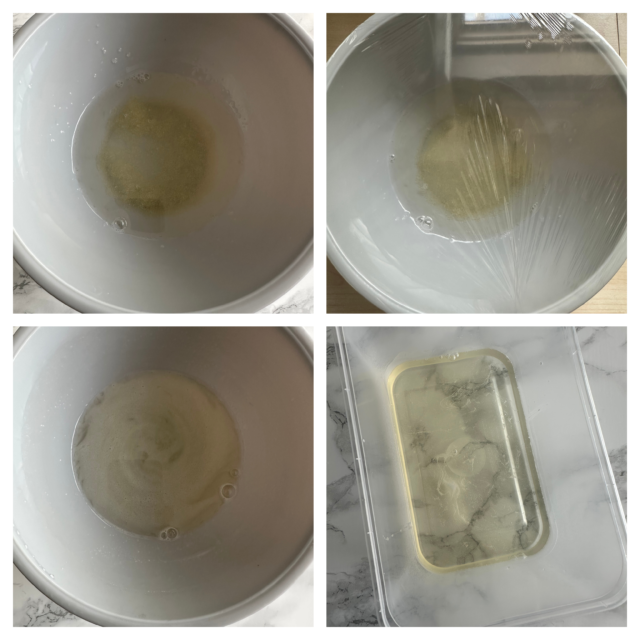
- Pour the water into a plastic bowl, then gradually whisk in the gelatine powder to prevent clumps.
- Allow the mixture to hydrate for about 10 minutes. You’ll notice the granules expand, forming a thick, sometimes rubbery, mass.
- Cover the bowl with cling film and microwave in 10-15 second increments, stirring after each, until the mixture becomes a clear liquid. Be careful not to boil it.
- Once dissolved, this gelatine mass can be decanted into a clean container and stored in the fridge for up to two weeks. When ready to use, simply cut off the required amount and roughly chop it into smaller pieces to help it dissolve easily into your recipe.
Adapting Gelatine in a Recipe: Now that we’ve covered the terminology and preparation, let’s explore how to adapt gelatine quantities in various scenarios.
Swapping Gelatine Forms (Same Bloom Strength)
Adapting between gelatine sheets and powder/mass is simpler than you might think, assuming the bloom strength is identical (e.g., both are 200 Bloom).
- Sheets to Powder/Mass: If a recipe calls for 10g of gelatine sheets, you can directly substitute 10g of gelatine powder. Prepare the powder using its correct hydration ratio (1:5 powder to water). If you’re using a pre-made gelatine mass (which is typically a 1:5 powder to water solution), a simple calculation applies: 10g powder + (10g powder * 5 parts water) = 60g gelatine mass. So, 10g sheets = 10g powder = 60g gelatine mass.
- Powder/Mass to Sheets: Conversely, if a recipe specifies 60g of gelatine mass and you have sheets (again, assuming identical bloom strengths), you can reverse the calculation. Since gelatine mass is a 6-part solution (1 part gelatine + 5 parts water), divide the mass by 6: 60g gelatine mass / 6 = 10g. Therefore, you would need 10g of gelatine sheets.
Adapting for Different Bloom Strengths
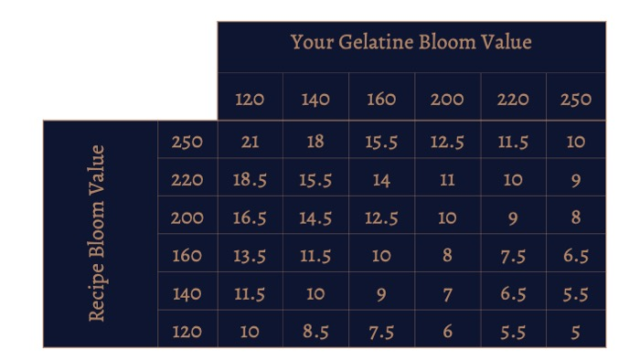
While gelatine forms are interchangeable, adapting for different bloom strengths is more complex. However, it’s a crucial skill to master to achieve the correct set and texture. My executive head chef taught me an easy calculation method, and you can also refer to the conversion table below to help you determine the precise quantity of gelatine required for your recipe.
Calculation Template:
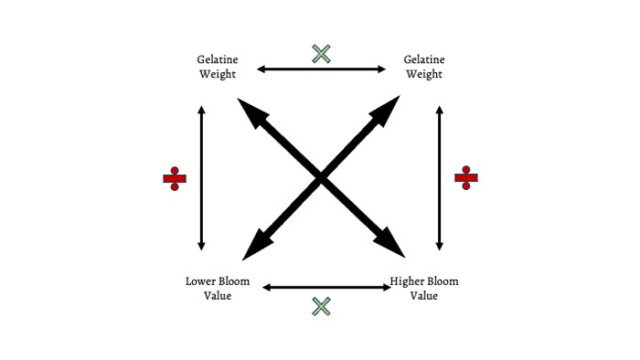
The is the basic template of how to calculate the value you need for gelatine or even bloom value.
Follow the basic rules of mathematics BODMAS (Bracket, Order, Division, Multiplication, Addition & Subtraction).
In this instance we simply divide before multiplying
Example 1: Your gelatine strength is lower.
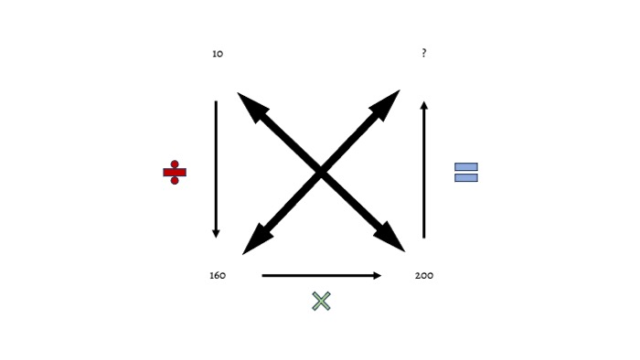
Recipe calls for 10g of gelatine 200 bloom, you have 160 bloom.
10 / 160 = 0.0625, 0.0625 x 200 = 12.5
We now know we need 12.5g of 160 bloom gelatine
Example 2: Your gelatine strength is higher.
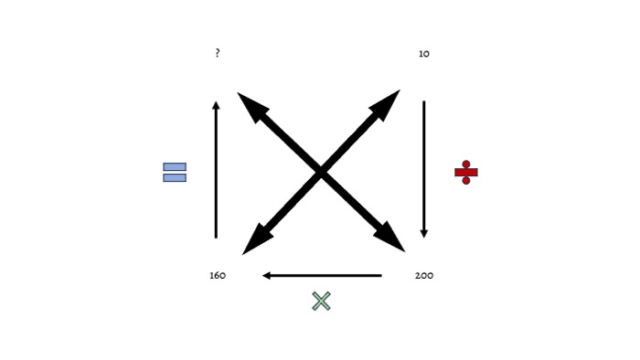
Recipe calls for 10g of gelatine 160 bloom, you have 200 bloom.
10 / 200 = 0.05, 0.05 x 160 = 8
We now know we need 8g of 200 bloom gelatine
With this method and the provided table, you’ll be able to confidently calculate the exact gelatine quantity needed, regardless of the bloom strength specified in the recipe versus what you have on hand.
My Top Tips
Here are some essential tips to ensure your gelatine-based creations set perfectly every time:
- Powdered Gelatine Preference: I generally prefer using gelatine powder for a few practical reasons. It’s more space-efficient to store than sheets, allows for bulk preparation of gelatine mass for future use, and fish-derived powder offers a halal and kosher option for diverse dietary needs.
- Adding Gelatine to Liquids: Always add bloomed or dissolved gelatine to warm liquids off the heat. Boiling gelatine or adding it to a rapidly boiling liquid will damage its gelling bonds, significantly weakening its setting power. Stir gently until completely dissolved.
- Accurate Sheet Gelatine Quantities: Be wary of recipes that specify gelatine sheets by count (e.g., “5 sheets”) without also providing a weight or brand. Sheet sizes vary significantly between manufacturers, so ‘5 sheets’ from one brand might not equal ‘5 sheets’ from another. Always prioritise recipes that provide gelatine quantities by weight for accuracy.
- Ensure Complete Dissolution: After adding bloomed gelatine or gelatine mass to your warm liquid, stir thoroughly until the gelatine is completely dissolved and the liquid is clear. Undissolved gelatine will result in a grainy or lumpy texture.
- Mind Acidic Ingredients: Be cautious with fresh fruits like pineapple, kiwi, papaya, and mango. These contain enzymes (like bromelain and papain) that can break down gelatine’s proteins, preventing it from setting. If using these fruits, they must be cooked or canned (which deactivates the enzymes) before being added to gelatine mixtures.
- Allow Sufficient Chilling Time: Gelatine needs time to set properly. Always allow your mixture adequate chilling time in the refrigerator, typically a minimum of 4 hours, or preferably overnight, for the best and most stable set.
My Recipes
Here are some of my favourite recipes where gelatine plays a starring role, helping to create incredible textures and stability:
- Milk Chocolate Crèmeux: A luxurious, smooth, and creamy dessert component, perfect for layering in cakes or serving on its own. Gelatine provides the ideal delicate set.
- White Chocolate Crèmeux: A versatile and elegant crèmeux with a rich, subtle flavour, often used as a filling or a light dessert. Gelatine ensures its perfect, melt-in-your-mouth consistency.